Anzac heroes of Hickeys Creek

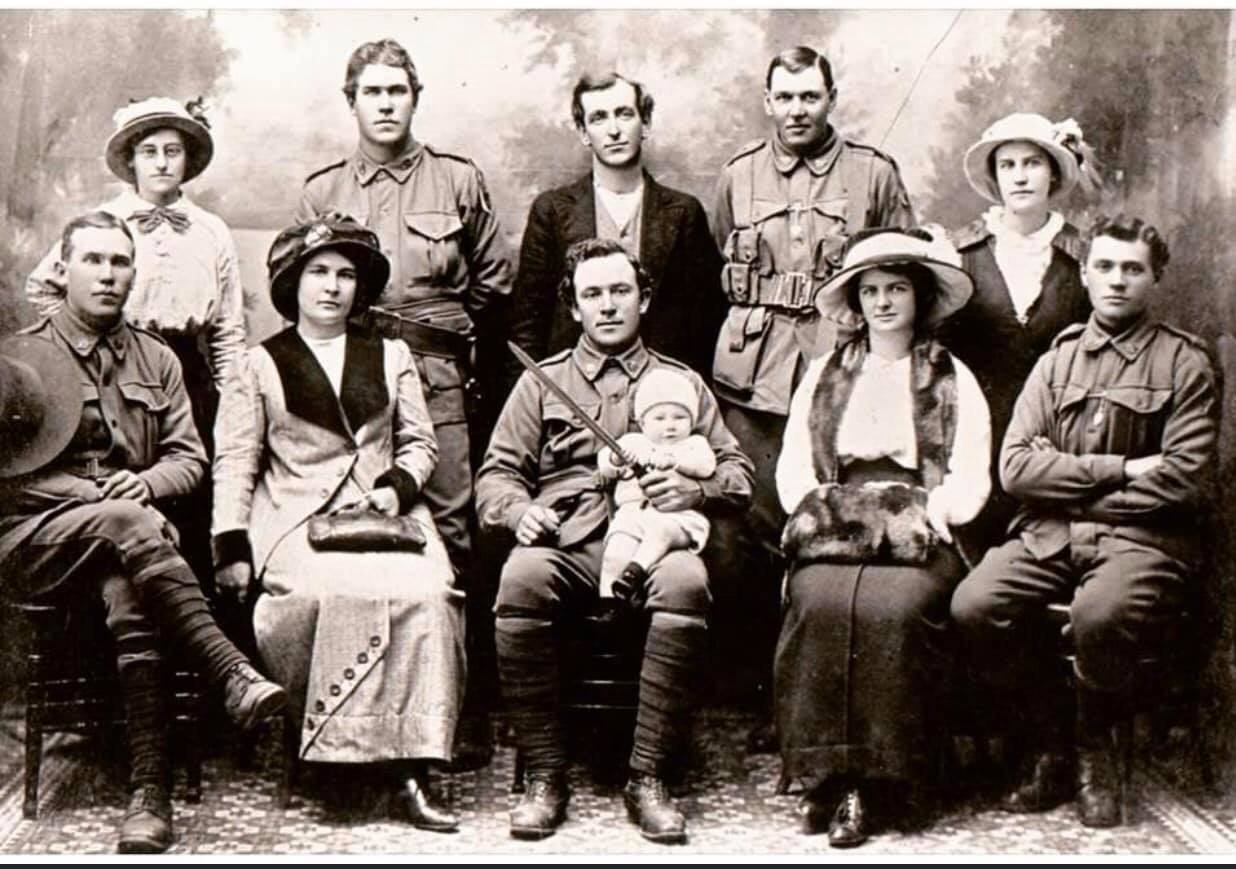
This picture is one of those finds you treasure and thank the family member for sharing it.

It is a picture of farewell, anticipation and fear. On the eve of leaving for war, the small community of Hickeys Creek in New South Wales are sending their men to a distant conflict. With the newly enlisted soldiers are their friends, sisters, wives and girlfriends. Baby Neville Fuller sits on his uncle’s lap.

In the back row, second from the left is Alonzo Hudson. His brother Justus is on the left in the front row. A third brother, Osman, also enlisted. The three brothers and the men pictured all fought in the 3rd battalion. The Hudson brothers fought to the end of the war and all returned to Hickeys Creek, Alonzo losing his leg in 1917. He received a Distinguished Conduct medal for his bravery.

In the front row on the far right is George Eldrige. George is an Englishman and a bootmaker. His experience during the war includes two hospitalisations for shell shock after the Battle of Pozieres. In May 1919 he marries Lilian Austin in Essex and applies to the AIF to return to Australia with his wife on a family transport. After the war 10,000 soldiers returned with wives they met and married in England, France and Belgium. Many of them already were pregnant or had children.

Jim Charlton, sitting in the middle of the front row, fought on Gallipoli and in France on the Western Front. He died from gun shot wounds on 22 March 1917. He is buried in St Sever Cemetery, Rouen. He had a wife and two children in Australia.

Oliver Waters, standing in the back row second from the right, fought on Gallipoli and was wounded during the Battle of Pozieres. He was in England recovering for over a year. Only a few weeks after returning to his battalion, he lost his life on 9 November 1917 during the Third Battle of Ypres. His body was never found. He is remembered on the Menin Gate and the Australian War Memorial.

We are lucky that Australia has records available online that enable us to piece together the story of our Anzacs. We can trace their experience through every day of their time away from their family and friends.

Lest we forget

Grave tales – Maclean Cemetery

When we travel to new towns you will always find us at the local cemetery. We photograph and document the memorials and add them to sites such as Findagrave so those doing family history research can find them.

When walking around the memorials, there are always a few that attract my attention. It could be because of the inscription, the age of the person who died, the size of the monument or some other unexplained reason. When this happens the genealogist takes over and I feel the need to find the story.

Last week I was in Maclean, a town founded by the Scots in 1862 on the Clarence River in northern New South Wales. The cemetery is on a hill on the town’s outskirts and has glimpses of the river.

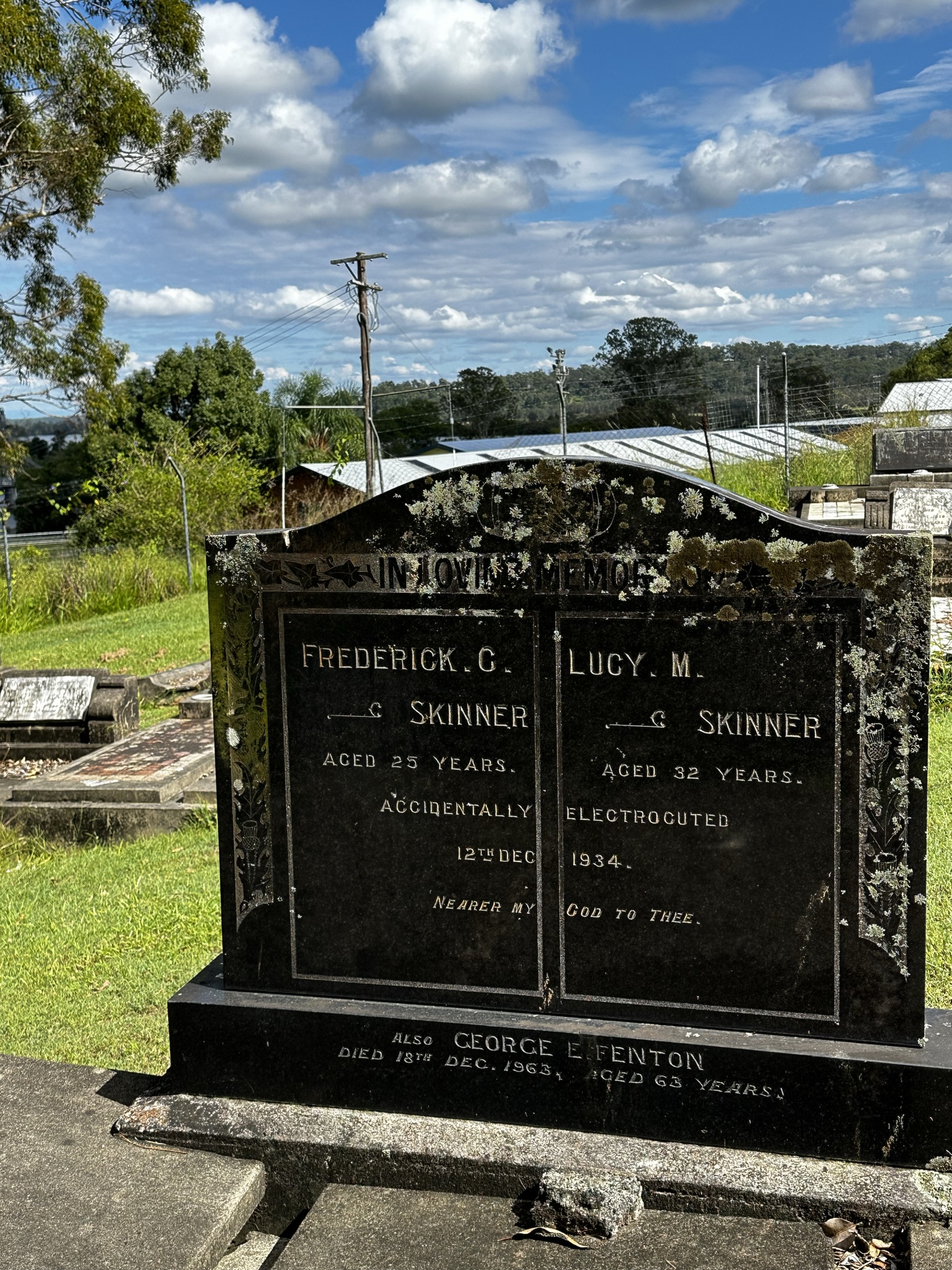
One memorial that attracted my attention was that of Frederick and Lucy Skinner, aged 25 and 32 years, accidentally electrocuted on 12 December 1934. How tragic that these two young people died on the same day.

The story was covered extensively in the newspapers across New South Wales. The Macleay Chronicle article of 19 December 1934, detailed the outcome of the inquest. The cause was a downed power wire carrying 11,000 volts from the Nymboida hydro-electric system. It is believed it was knocked to the ground after an altercation with a flying fox.

On the morning of 19 December, the neighbour Mr Towell found one of his cows knocked down and lying on the ground. He yelled for help. Fred Skinner ran to the aid of his neighbour and in the process touched a piece of wire used as a bind for the gate. He had no idea the gate was electrified by the fallen power wire and was immediately thrown backwards, his hands still on the gate.

In response to Fred’s screams, his sister Lucy ran to help and, as she tried to drag him away from the fence, she was also electrocuted. Her brother Harold, aged 19 and sister Daphne, 14 also ran to help. Daphne received a shock but was thrown free and survived.

The children were living on the farm of their parents William and Una Skinner. William Skinner was a well known market gardener in the area. William and Una had eight children. The devastating tragedy that occurred that day resulted in William’s decline in health. He died two years later at the age of 65.

Does your tree need a trim?

I recently saw a post in a Facebook group showing an Ancestry tree hint for a family. The post’s author said he had clicked on a hint and received a list of nearly 60 children associated to one couple. This list came from an Ancestry member tree.

How does this happen? It is pretty easy on Ancestry to add more than one of the same person when reviewing a hint. If you click too many boxes without knowing what is already on your tree, before you know it there are duplicates and people that don’t belong, adding to the branches.

Most genealogists will tell you not to take Ancestry trees as evidence for your tree. They are collated from hints offered by the program but these hints need to be reviewed closely before adding them and then once added, checked against other evidence to ensure everything is correct. It is hard to imagine getting into a state as bad as the tree in the picture.

These trees can be fixed however. We use a process to check and fix trees that have got themselves into a bushy state. We can trim the duplicates and eradicate the weeds – those people not related to you. Once your tree is trimmed it is much easier to see the branches and get to adding the right leaves.