Grave Tales – Old Dubbo Cemetery

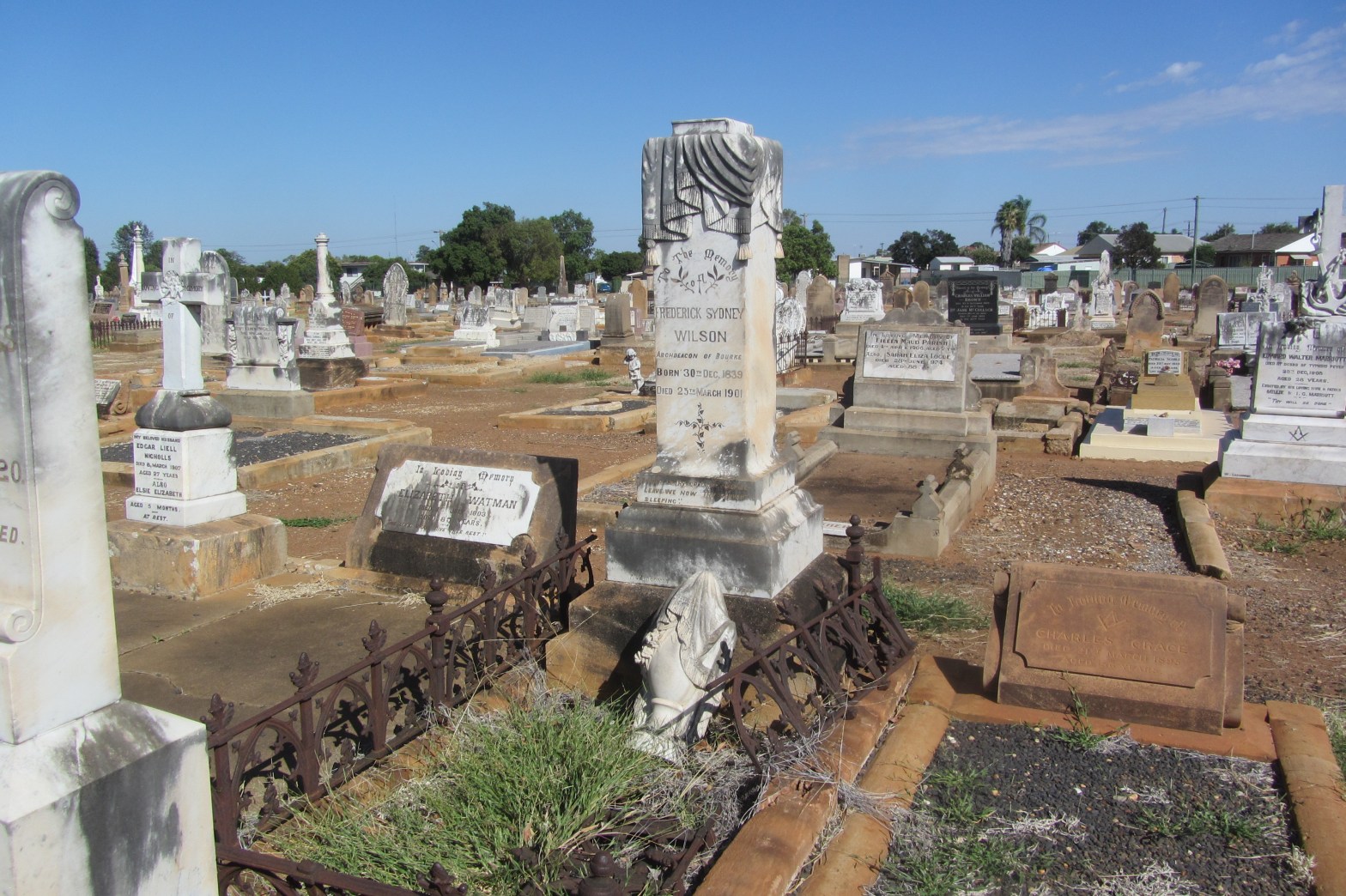
The tale of a journalist and writer turned man of religion is one of following passions and a true path. Frederick Sydney Wilson was a successful writer and editor of a Sydney newspaper before he turned his back on city life to join religion in the western towns of New South Wales.

Frederick was born on 30 December 1839 in Sydney, New South Wales. His father was the successful engraver, William Wilson. His father and mother Elizabeth were English-born and emigrated with their three youngest children in 1828.

After his education Frederick commenced work as a mercantile clerk but started writing poetry and short stories. His poem, Stars of the Heavens was first published in the Sydney paper, The Empire in 1860.

Over eighty poems and short stories written by Frederick Wilson were published in Sydney newspapers and journals between 1860 and 1872. His journalism appeared in the Illustrated Sydney News, The Empire and the Illawarra Mercury.  He wrote regular sketches about the people and places of Sydney for The Australian Journal, which later became The Colonial Monthly. 

On 23 August 1865, at Sydney, he married Caroline Jemima Robinson, daughter of Frederick Robinson, ironmonger and known for his involvement in the Deaf and Dumb and Blind Institution.

In 1870 Frederick Wilson published a book, Australian Songs and Poems. It included poetry published in newspapers and journals of the previous ten years. The book was met with mixed reviews stating his early works ‘struck off from time to time, apparently without much preparation, or without effort.’ Then stating his later work as ‘beautiful’ and ‘Mr Wilson could stake his claim to be considered a poet in the full sense of the word.’ Another review stating, ‘many of his poems display great carelessness in their construction but when his heart is thoroughly attuned to his subject his pathos is evidenced in the most touching and exquisite language.’

In the early 1870’s Frederick Wilson took on a career change and began studies at Moore College, Liverpool to become a minister of the Church of England. In 1874 he was ordained as a minister by Bishop Samuel Marsden at the Holy Trinity Church Kelso, New South Wales. Soon after he was appointed minister for the Holy Trinity Church in Grenfell, New South Wales.

In 1877 tenders were called to build a new church for the Grenfell residents to replace the inadequate wooden structure. Reverend Wilson was chair of the committee to oversee the construction. The foundation stone was laid on 24 May 1877. The official opening occurred on 2 February 1879 by the Bishop of Bathurst, the Right Reverend Dr Samuel Marsden.

On 27 September 1881 Frederick Wilson was promoted to the ministry at the Holy Trinity Church in Dubbo. During his time in Dubbo, he organised building of the new rectory and the Sunday School Hall. The Sunday School Hall was built with most of the cost met by gifts from the parishioners. He orchestrated reduction of the church debt by over £1,000 in a time of economic depression and the onset of drought. In 1888 he was promoted to the position of Archdeacon of Dubbo and two years later travelled to England for further study.

He was referred to as having great intellectual power and whose light ‘shone before men.’ He was noted to be a lovable man who radiated goodness and tenderly controlled his flock. His services were evangelical, and he never raised his voice in a rant.

He closed one of his last sermons with, ‘I hope to meet Death as I have met Life – bravely.’ His last service was the marriage of his daughter Eva to the bank manager, Percival Smith. Archdeacon Wilson died on 25 March 1901. The funeral was the biggest seen in Dubbo at the time with over sixty vehicles in the procession. He is buried in the Old Dubbo Cemetery. He was survived by his wife, three daughters and two sons with a daughter having died in 1878.

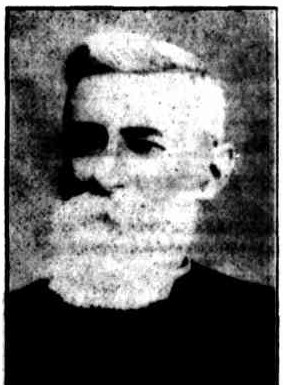
Photo of Frederick Sydney Wilson from the newspaper.

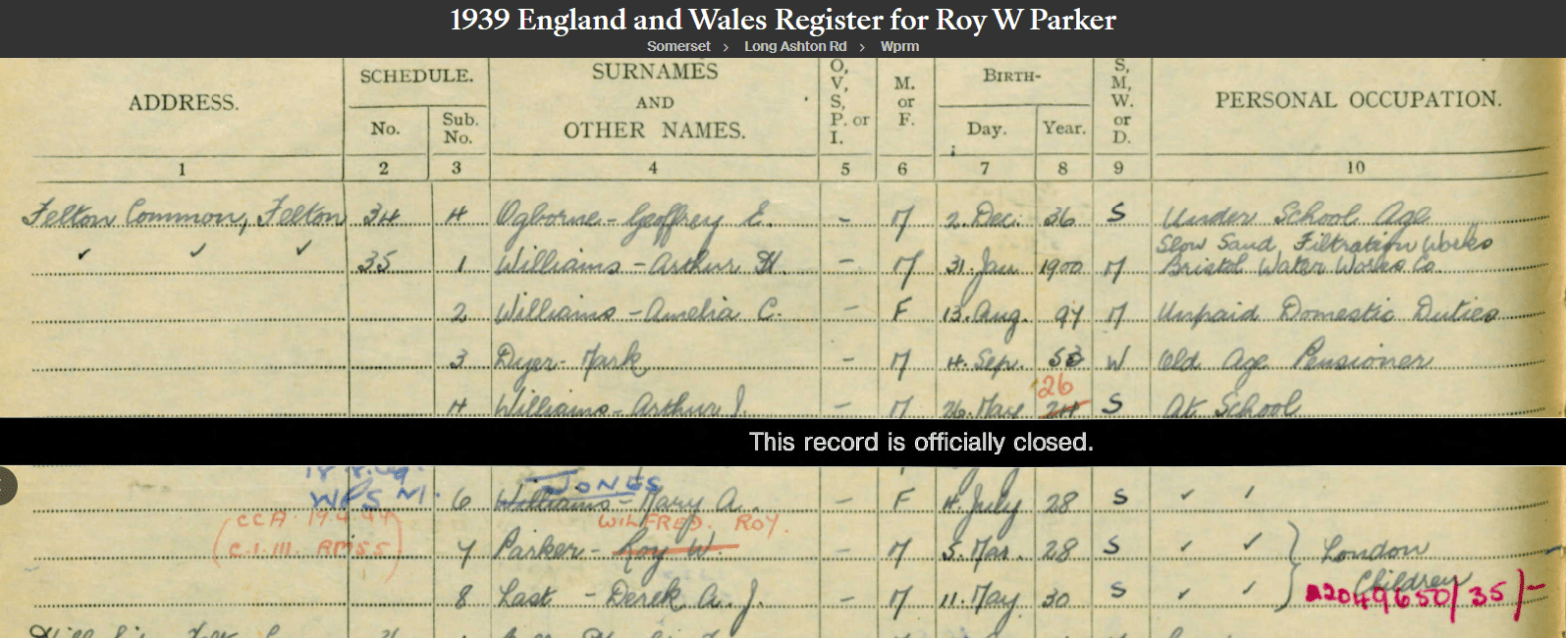
Redacted on the 1939 register

There is often confusion about the English 1939 register and whether it is a regular census. The 1939 register is not a census, but a register collated in September, just after the start of World War Two. It is not covered by the Census Act 1920, so not subject to the 100 year closure rule which is why we already have access to it.

The register is a snapshot of England on the eve of war. Children had been evacuated, but conscription hadn’t started. It is the only listing of the population between 1921 and 1951. The 1941census did not go ahead due to war and the 1931 census was destroyed by fire in 1942. The records are contained in 7000 volumes.

The big difference between the register and a census is the purpose. The census is a big market research study of the population. There are no relationships or birthplaces on the 1939 register, but it has full dates of birth which are not found in the census.

The register was needed to get everyone listed at a point in time so they could get a National Identity card and a ration book. It was used to direct labour and monitor and control the movement of the population caused by evacuation. In later years of the war it was used for conscription.

The form was left with every household on registration night and then collected a few days later. Despite taking a full register of the population in 1939, the government still intended to go ahead with the 1941 census and used many of the enumerators employed to complete the census and employed many more than was required for a census. Districts were smaller so extra enumerators could get around easier and complete the process in a shorter timeframe.

The picture above shows the record for Wilfred Roy Parker aged eleven. He is from Essex and has been evacuated to Somerset to live with a family and three other boys his age. A record on the page is redacted with a thick black line. The record of anyone born less than 100 years ago is closed unless they are known to have died. Records can be opened on request however a volume number is needed. This can be difficult if they are not living with known family and almost impossible to find someone across 7000 volumes if they had been evacuated or living in a different area away from family.

Another benefit of the register is they were annotated for 60 years after the register was taken. Annotations were made on the register for a change of name which could be due to marriage or the correction of an error. Some notations also included a date which was the date the change was notified. The notation is often in red which makes it easier to spot.

It must have been a scary experience for the children of England to leave their parents and be sent to the country with strangers. There are still some people I haven’t found on the register because of redaction. Redactions are being removed regularly so I suggest you keep going back and doing another check. You never know when someone will appear.

Lest we forget


The Young Chronicle, on 24 August 1915 highlighted the fate of cousins William Sydney McCarthy and Frederick Prothero on Gallipoli and Thomas Leslie Debnam on Malta. Their story is recounted below:

Three Cousins. TWO DEAD, ONE WOUNDED.

Soon after the war started three cousins, all fine stamps of hardy Australian manhood, left Young to do duty for their country. They left with the first contingent, trained in Egypt and then went on to the Dardanelles, where there is no reason to doubt they fought with the bravest. These cousins were Privates Fred Prothero, Tom Debnam and W. McCarthy, all natives of Young. We very much regret to say that two of these young men now fill heroes graves on foreign soil, but their names are not last on the scroll of fame, for they are amongst those who made Australia and her noble sons which will last throughout the ages after peace is restored.

Private W. S. McCarthy, whose photograph appears in the “Telegraph” which came to hand this morning was first of all reported missing. A brother in Sydney, however, received from a friend of the brave young soldier at the front a message to say that he had been killed, and also enclosed a letter for him which he stated he had taken from the dead man’s tunic pocket. The letter was written by the soldier in the trenches for his brother, but he had not had time to post it before he fell a victim to the Turkish bullets. The receipt of the letter and the fact that the military authorities had reported Private McCarthy as missing only, led to investigations, with the result that he has now been officially reported as killed.

Private Debnam, whose death was recorded early this month, died from a wound to the skull, whilst Private Prothero was returned with the first batch of sick and wounded and subsequently spent several days in this, his home town. Happily he still very much alive, and is so imbued with the fighting spirit that he is anxious to get back amongst his fellows as soon as he can manage it. He has gone back to Sydney with that object in view.

But Young must feel proud of these three gallant cousins. Two we shall not see again, but we have hopes that Private Prothero will come through safely after revenging the deaths of his relative’s and comrades, and also after taking part in the great triumphant march to Constantinople, the ancient city which is ere long to be returned into the hands of the Christians.