Grave Tales – Tingalpa Christ Church

The Tingalpa Christ Church and cemetery is a little piece of history remaining in Brisbane, now surrounded by industry and traffic. The sound of pressurised gas and the smell of fried potatoes waft from the Smiths Factory next door and the rumble of trucks and cars travelling the six lanes of Wynnum Road is ever present.

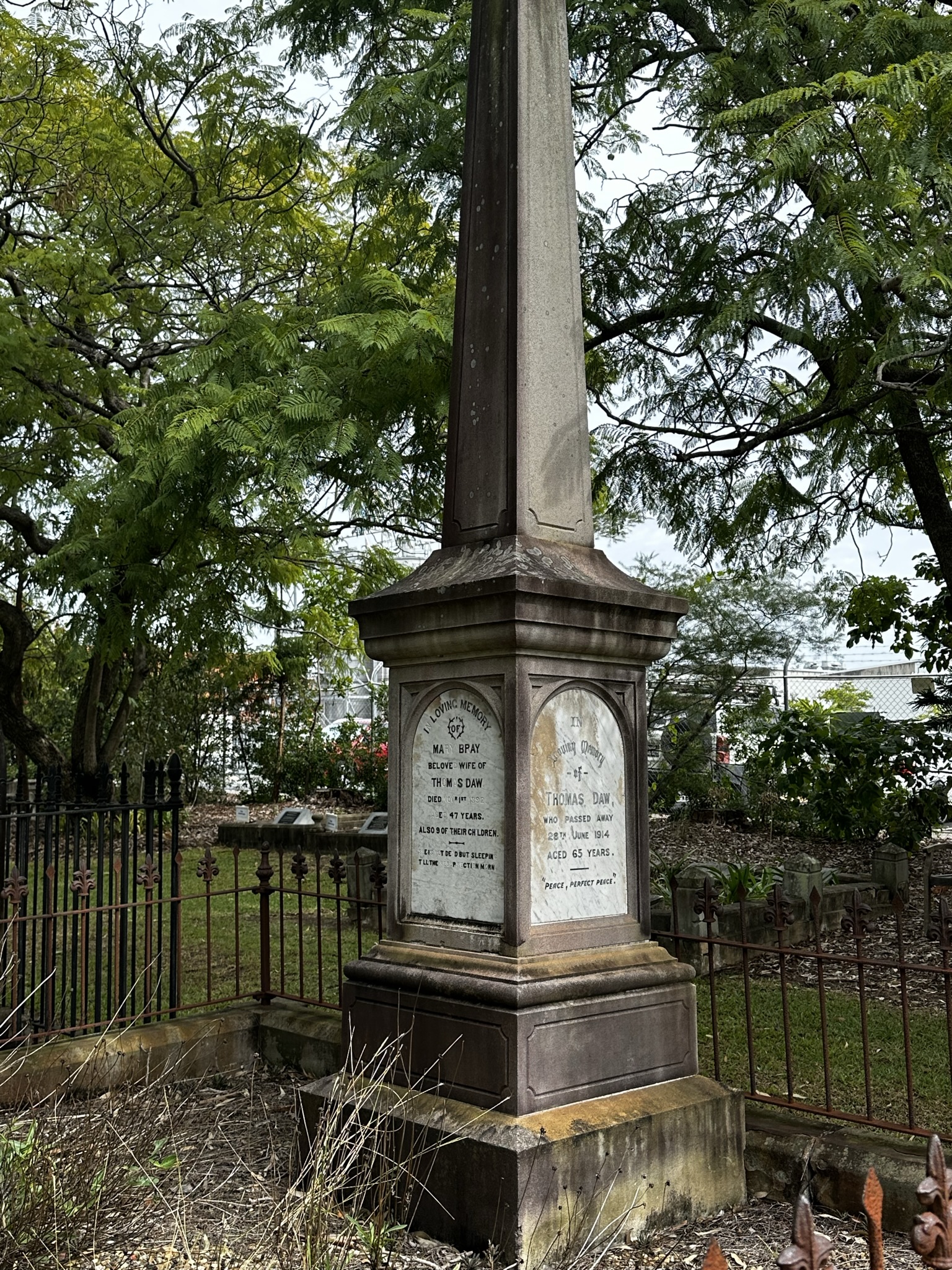
Within the grounds are the graves of many pioneers of Brisbane’s eastern suburbs. There are single graves and family plots. Towards the back corner is a plot surrounded by an ornate iron fence. The memorial is a tall spire of sandstone. The front facing panel acknowledges the death of Mary, beloved wife of Thomas Daw, died 1 Nov 1892, aged 47 years. Also 9 of their children.

There are no names of children on the memorial so it is easy to walk past this plot without realising the extent of family tragedy enclosed within. The situation becomes more apparent when research reveals all nine of the children were in infancy when they died.

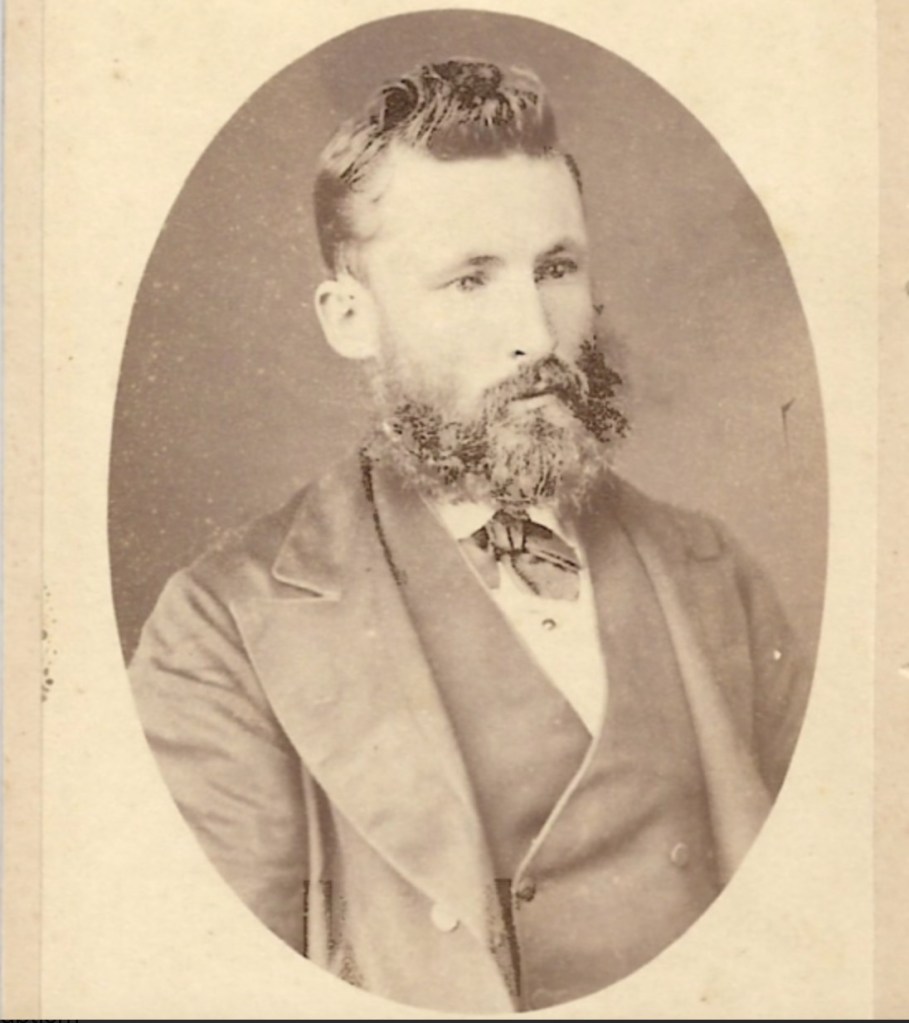
Thomas Daw and Mary Daw nee Ellis were from Devon, England. In 1871 they are living close by in Paignton. Mary is a domestic servant and Thomas an agricultural labourer. They marry on 28 July 1872, Mary is four years older than Thomas. A few months later the newlyweds board the Royal Dane, bound for Moreton Bay.

Thomas Daw gains employment with the Robinson family at Tingalpa then owns his own butchery business on Gympie Road at Lutwyche and later is elected as a councillor of Windsor Shire.

Their first son Robert James Daw is born on 17 July 1873, six months after their arrival. He is the only child of ten to survive into adulthood. Without each death certificate on hand, the cause of the deaths of the children is not known but one online post records two of the children dying from gastro-enteritis.

The children are Mary Elizabeth 1875, two months, Florence Eleanor 1876, two months, William Henry 1877, one month, Albert Edward 1878, four months, Alice Ann 1881, three months, Thomas George 1883, eleven months, Frederick Ernest 1885, five months, Ethel Maud, 1887, one month, Elspeth Rose, 1889, one month.

On Sunday 30 October 1892 Mary Daw attends church at St Andrews Lutwyche but shortly after returning home is struck with severe abdominal pain. Despite help from three doctors she dies in the early hours of Tuesday morning. The funeral takes place in Tingalpa, attended by many of all classes. Mary is laid to rest with her nine children.

Thomas Daw marries Emily Perry ten months later. They have two daughters who live long lives. Thomas dies on 28 June 1914. He is buried with his first wife and chidren at Tingalpa.
Looking beyond Ancestry

Most of us in Australia use Ancestry to build our family tree. There are limitations with the records available online and limitations with record sets that can’t be released until a time period has past. The limitations with this is that the records have a release date, so births, marriages and deaths are available only after a time period has past, depending on the state. This is designed to protect the living.

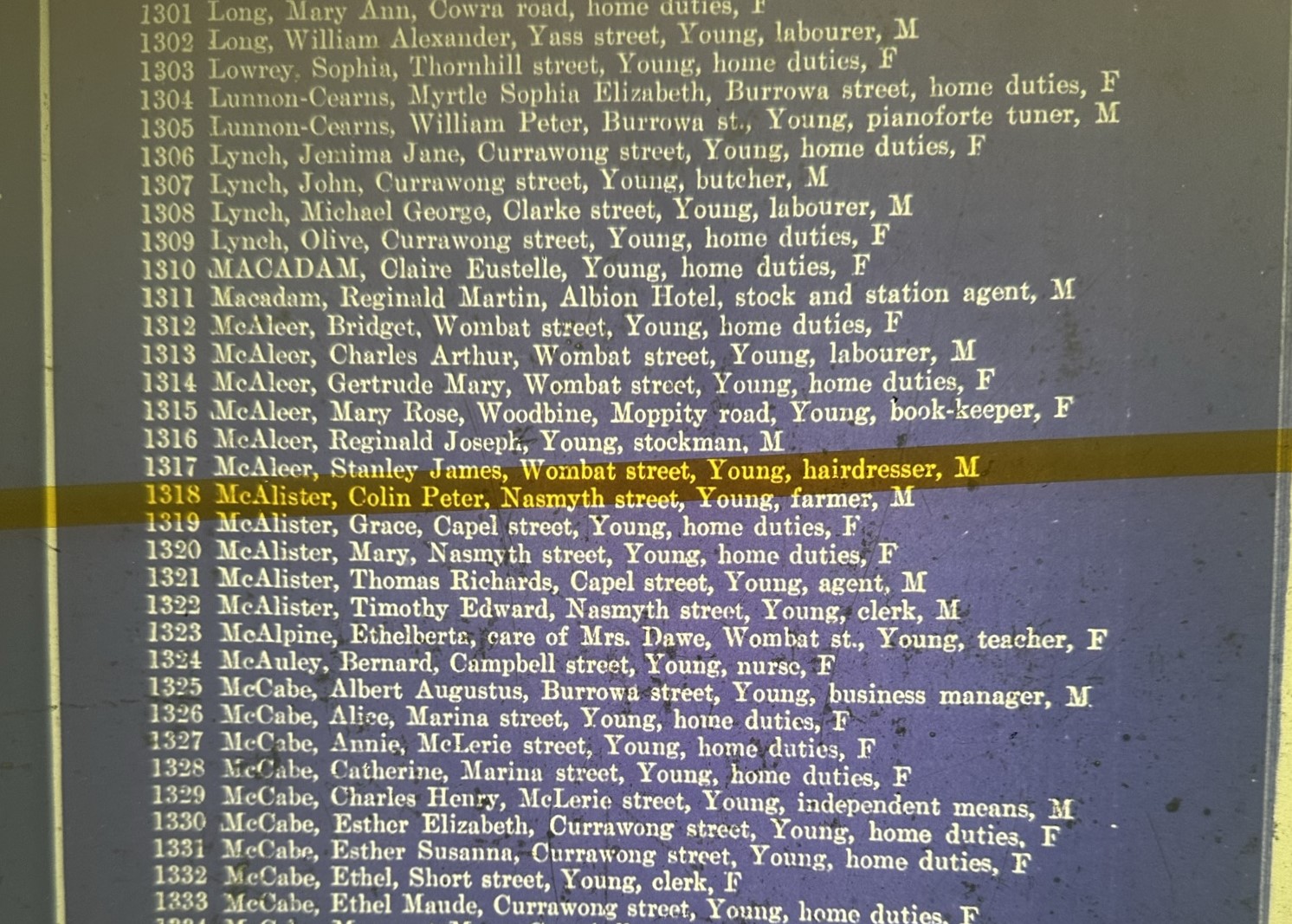
One of the best set of records to trace a person are the electoral rolls but they are not all online. Ancestry does not hold every year and they end at 1980 so if you are looking for someone born after 1922 and still alive after 1992 then electoral rolls are the answer.

The rolls can help you find past and current generations. There are many reasons why you may need or want to look for the living when building a family tree. An obvious one is looking for an unknown parent or grandparent with the use of DNA plus genealogy. There are other reasons, such as looking for a long lost living relative , returning a discovered heirloom or finding someone who may know stories about the family.

Where do you find them? Most state libraries have the Commonwealth electoral rolls available deep into the 2000’s and I have spent hours at the library searching electorates year after year to trace a family. It is very satisfying when you find a child appear in the household after they turn 18 then follow them until a partner and their children appear.

But don’t forget the State electoral rolls. The Queensland electoral rolls are a goldmine of information. They have notations that show where a person moved and name changes after marriage so if you lose someone on the Commonwealth rolls check out the state rolls.

The wanderings of John McCarthy

When you research a family story for a person living in the 1800’s and even into the early 1900’s you don’t expect a person to move very far in their life. There are some however that move due to circumstances such as running from the law, running from a family or external events such as the gold rush, land rush or fighting in a war .

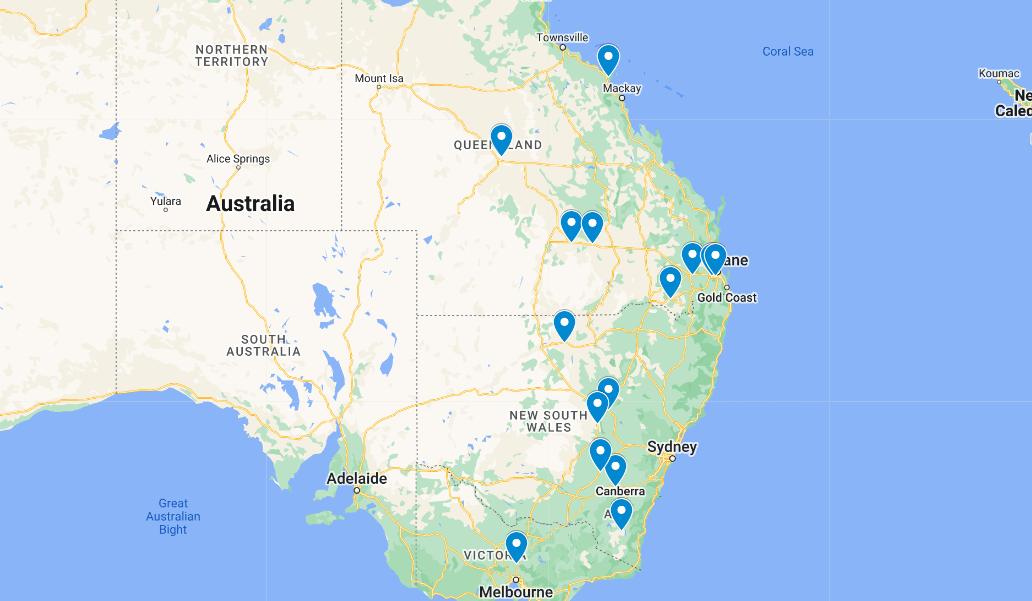
Of all the people I have researched John McCarthy is far ahead of anyone in the number of places he has lived. When this happens it takes extra research and evidence to confirm it is the same person and not another person of the same name.

Here is the timeline of John McCarthy 1845 – 1911. Let me know if you have seen anyone with more home towns than John.

1845 – Darling Downs John McCarthy was born in 1845 on the Darling Downs at a time when it was a fledgling town. His father was a carpenter and workers were need to help build a settlement.

1849 – Yass John’s brother Patrick is born.

1853 – Kilmore The next three children are born here with the last child Thomas being born in 1858.

1860 – Cooma John’s mother Mary dies. His father returns to Queensland.

1877 – Young John marries Eliza Fox. The family don’t consider him good enough to be her husband. The gold rush attracted thousands to Young. John is still a miner at the time of their marriage. Their first four children are born in Young. The second daughter Francis dies at 20 months old in 1882.

1884 – Memegong Station near Young Child number six, Catherine is born on the property.

1885 – Dubbo The next two children, George and Clarinda, are born in Dubbo. Clarinda in 1889.

1890 – Peak Hill John deserts his wife Eliza and five children in the mining town and is chased by Police. He is believed to be in Brewarrina or Bourke. He is returned to Peak Hill and discharged. His son William is born in February 1891. It is unknown if he remains with the family. Eliza dies at Peak Hill in 1895. The children live with family in Young.

1901 – Longreach John changes his name and marries Sara Ottery at Longreach registry office.

1902 – Mount Marlow Sarah dies as they travel.

1906 – Morven John is on the electoral roll living at the Royal Hotel

1910 – Warwick John registers a birth of a son Francis Walter McCarthy who is born in 1908 in Inglewood. The mother is Elizabeth Petersen. He is living in Mitchell.

1911 – Mitchell The birth of John’s son with Elizabeth, Collin John McCarthy. He marries Elizabeth soon after. He is 68, she is 26. Elizabeth returns to her hometown of Mackay. John is in Mitchell and ill with turberculosis. He sends her a final letter signing off with love.

1911 – Goodna John is sent to Goodna Asylum to live his last days. His death certificate has enough details to match him to the father of the McCarthy children of Young.