
In October last year, I was excited to attend a function for Natasha Lester as she launched her new book, a novel of historical fiction called The Three Lives of Alix St Pierre. Natasha’s books are works of fiction set during a time in history and weaving in characters who lived during that time or inspired by real people.
During question time, an audience member asked her about those who criticise authors for not sticking to historical fact or getting facts wrong. Her answer was perfect. What she writes is fiction and even works of historical non-fiction may be not be 100% correct. They are a person’s perspective, an interpretation, or a story told by someone who was there but may have witnessed the event and recounted it differently to another person.
This is also true of researching and collating our family history. They teach us to rely on primary sources, such as birth and death certificates. These include facts direct from the source, but who is the informant providing that information? Have they got the correct details? Have they told the truth? Were they told the truth? Were there circumstances that led them to lie?
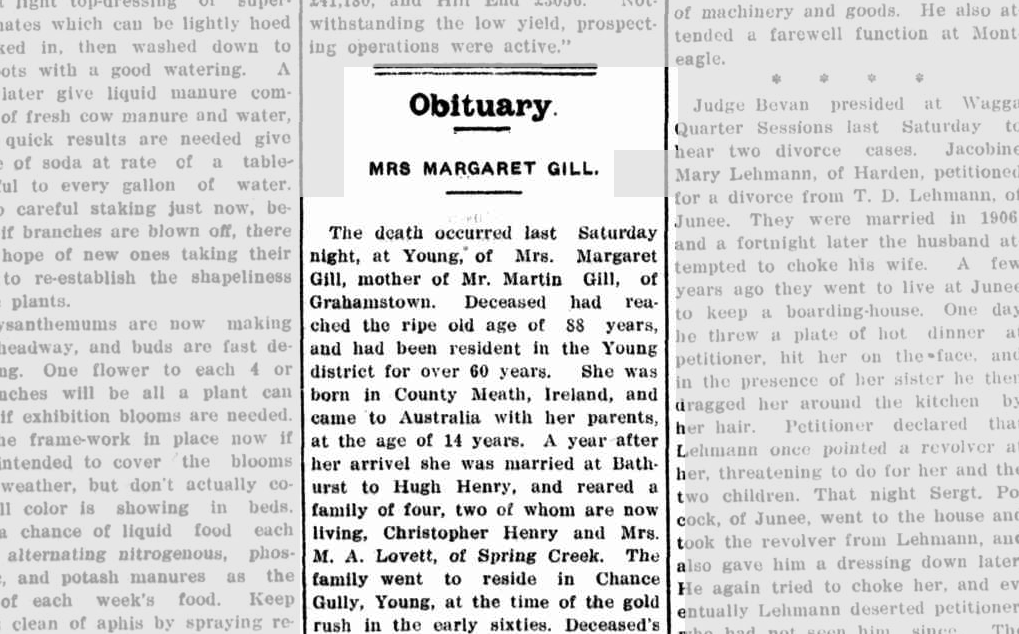
The obituary of my 3rd great-grandmother Margaret Wogan is an example of historical fact with a mix of historical fiction. It states she came to her Australia at 14 with her parents. Margaret was an Irish orphan living in a workhouse when she was put on a ship to Australia as part of the Earl Grey Scheme to provide the colony with female labour and wives for its male population.
Stories of the female Irish orphans were often in newspapers during the 1800’s. They were the cause of society’s problems. They were reported to have fought and cursed and stolen and acted in a debaucherous manner. Because of the criticism of the orphans, the scheme ended two years after it had started.
Who told the journalist the fib about the young immigrant arriving with her parents? Margaret may have told the story herself to her children to distance herself from the reputation of the Irish orphan girls. This is one of several fibs in her obituary. Margaret concealed a relationship, while her first husband still lived, and also hid the girls born to that man.
Journalists of the time gained their facts from family or wrote about their knowledge of the deceased person. Were they told the truth or a fiction that helped the person fit into societal norms? Just because it is written does not make it true.
 Trace Genealogy