
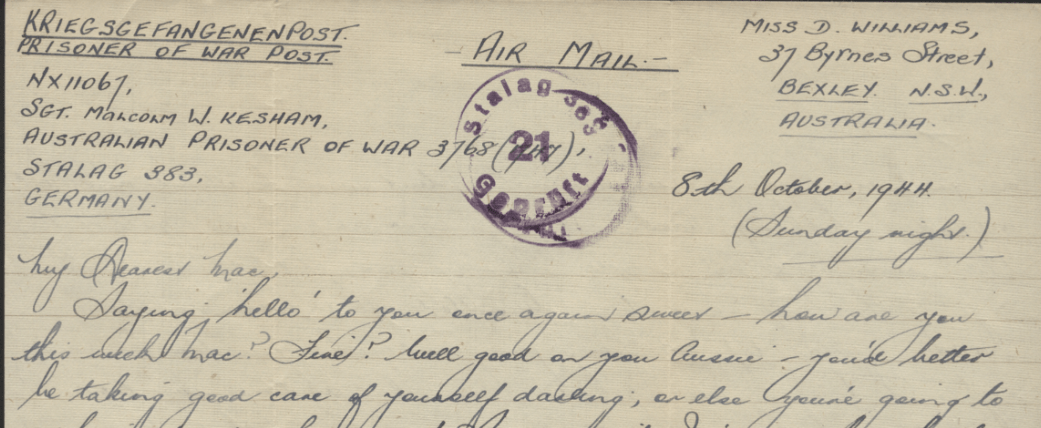
Yesterday the Australian War Memorial announced a request for volunteers to assist them to transcribe thousands of love letters written between soldiers and their loved ones at home during the major conflicts.
I signed up to the website and started to transcribe a letter from Dorothy Williams to her love Malcolm ‘Mac’ Keshan. The letter was addressed to Malcolm at Stalag 383, a prisoner of war camp in Germany which housed 8,000 British and Allied soldiers during World War II. It was written in March 1944. The letter spoke of her work and social life, attending theatre with friends and going to the pictures with her mum. She also reflected on the fun times she had with Malcolm before he enlisted and went to War.
Dorothy, known as Dot, and Mac met at the Grace Building in Sydney where he was working as a lift driver. On 26 March 1940, Mac volunteered to join the Australian Imperial Force and left for overseas service.
Mac was sent to the Middle East and tasked with training men. He was transferred to the 2/4th Infantry Battalion and served in North Africa in Tobruk, Derna and Benghazi before being sent with his battalion to defend Greece. While there he was taken prisoner by the Germans. It was early 1941. He was sent to various prison camps and made two unsuccessful attempts at escape. The letter I transcribed was in October 1944 when Mac was interred at Stalag 383.
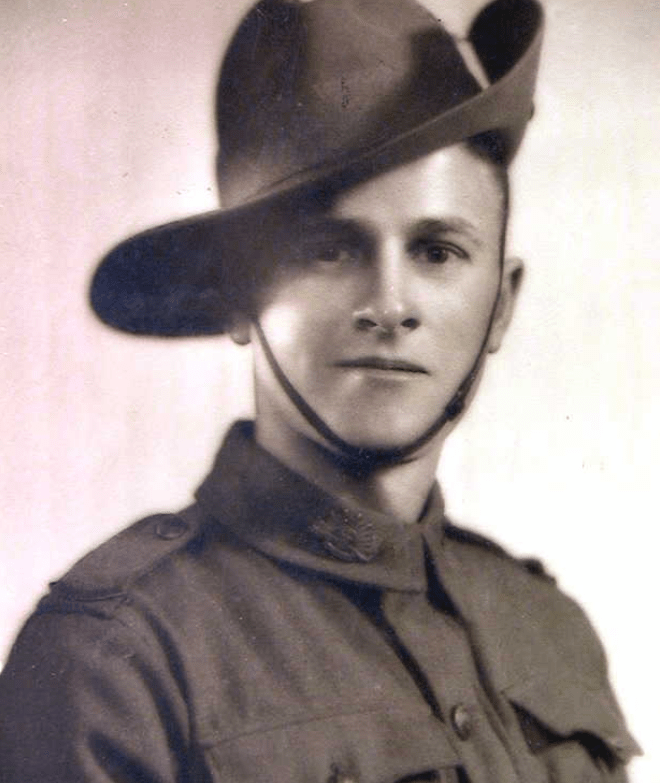
In April 1945 Mac again attempted escape from the prison camp with two other prisoners. They were successful and lucky for them ran into the advancing US army at Neustadt. They were returned to England and there for the celebrations for V Day on 8 May 1945.
Mac returned to Australia in June 1945 where he worked in dry cleaning and eventually purchased his own dry cleaning business. Mac and Dot were married on 5 October 1946. They lived in Bexley, a suburb of Sydney and had three sons. Malcolm William Keshan died on 10 May 2014 at age 94.
Mac and Dot’s letters are now in the War Memorial’s collection and are an intimate insight into the relationship and how they remained positive during the wartime. These letters were so important to the Australians fighting overseas, away from their loved ones for years, often under high stress and unsure of the outcomes. Now they will be preserved and available for future generations to appreciate their important part in history.
 Trace Genealogy
What an exciting project to participate in! Thanks for sharing one of the stories you encounter in it.
LikeLike
It is a wonderful project. The War Memorial do great things to preserve history.
LikeLiked by 1 person