
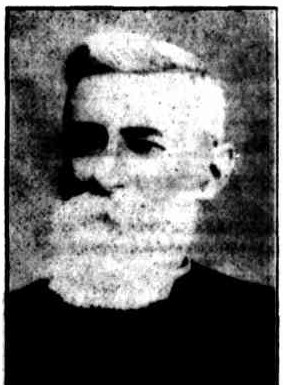
The tale of a journalist and writer turned man of religion is one of following passions and a true path. Frederick Sydney Wilson was a successful writer and editor of a Sydney newspaper before he turned his back on city life to join religion in the western towns of New South Wales.
Frederick was born on 30 December 1839 in Sydney, New South Wales. His father was the successful engraver, William Wilson. His father and mother Elizabeth were English-born and emigrated with their three youngest children in 1828.
After his education Frederick commenced work as a mercantile clerk but started writing poetry and short stories. His poem, Stars of the Heavens was first published in the Sydney paper, The Empire in 1860.
Over eighty poems and short stories written by Frederick Wilson were published in Sydney newspapers and journals between 1860 and 1872. His journalism appeared in the Illustrated Sydney News, The Empire and the Illawarra Mercury. He wrote regular sketches about the people and places of Sydney for The Australian Journal, which later became The Colonial Monthly.
On 23 August 1865, at Sydney, he married Caroline Jemima Robinson, daughter of Frederick Robinson, ironmonger and known for his involvement in the Deaf and Dumb and Blind Institution.
In 1870 Frederick Wilson published a book, Australian Songs and Poems. It included poetry published in newspapers and journals of the previous ten years. The book was met with mixed reviews stating his early works ‘struck off from time to time, apparently without much preparation, or without effort.’ Then stating his later work as ‘beautiful’ and ‘Mr Wilson could stake his claim to be considered a poet in the full sense of the word.’ Another review stating, ‘many of his poems display great carelessness in their construction but when his heart is thoroughly attuned to his subject his pathos is evidenced in the most touching and exquisite language.’
In the early 1870’s Frederick Wilson took on a career change and began studies at Moore College, Liverpool to become a minister of the Church of England. In 1874 he was ordained as a minister by Bishop Samuel Marsden at the Holy Trinity Church Kelso, New South Wales. Soon after he was appointed minister for the Holy Trinity Church in Grenfell, New South Wales.
In 1877 tenders were called to build a new church for the Grenfell residents to replace the inadequate wooden structure. Reverend Wilson was chair of the committee to oversee the construction. The foundation stone was laid on 24 May 1877. The official opening occurred on 2 February 1879 by the Bishop of Bathurst, the Right Reverend Dr Samuel Marsden.
On 27 September 1881 Frederick Wilson was promoted to the ministry at the Holy Trinity Church in Dubbo. During his time in Dubbo, he organised building of the new rectory and the Sunday School Hall. The Sunday School Hall was built with most of the cost met by gifts from the parishioners. He orchestrated reduction of the church debt by over £1,000 in a time of economic depression and the onset of drought. In 1888 he was promoted to the position of Archdeacon of Dubbo and two years later travelled to England for further study.
He was referred to as having great intellectual power and whose light ‘shone before men.’ He was noted to be a lovable man who radiated goodness and tenderly controlled his flock. His services were evangelical, and he never raised his voice in a rant.
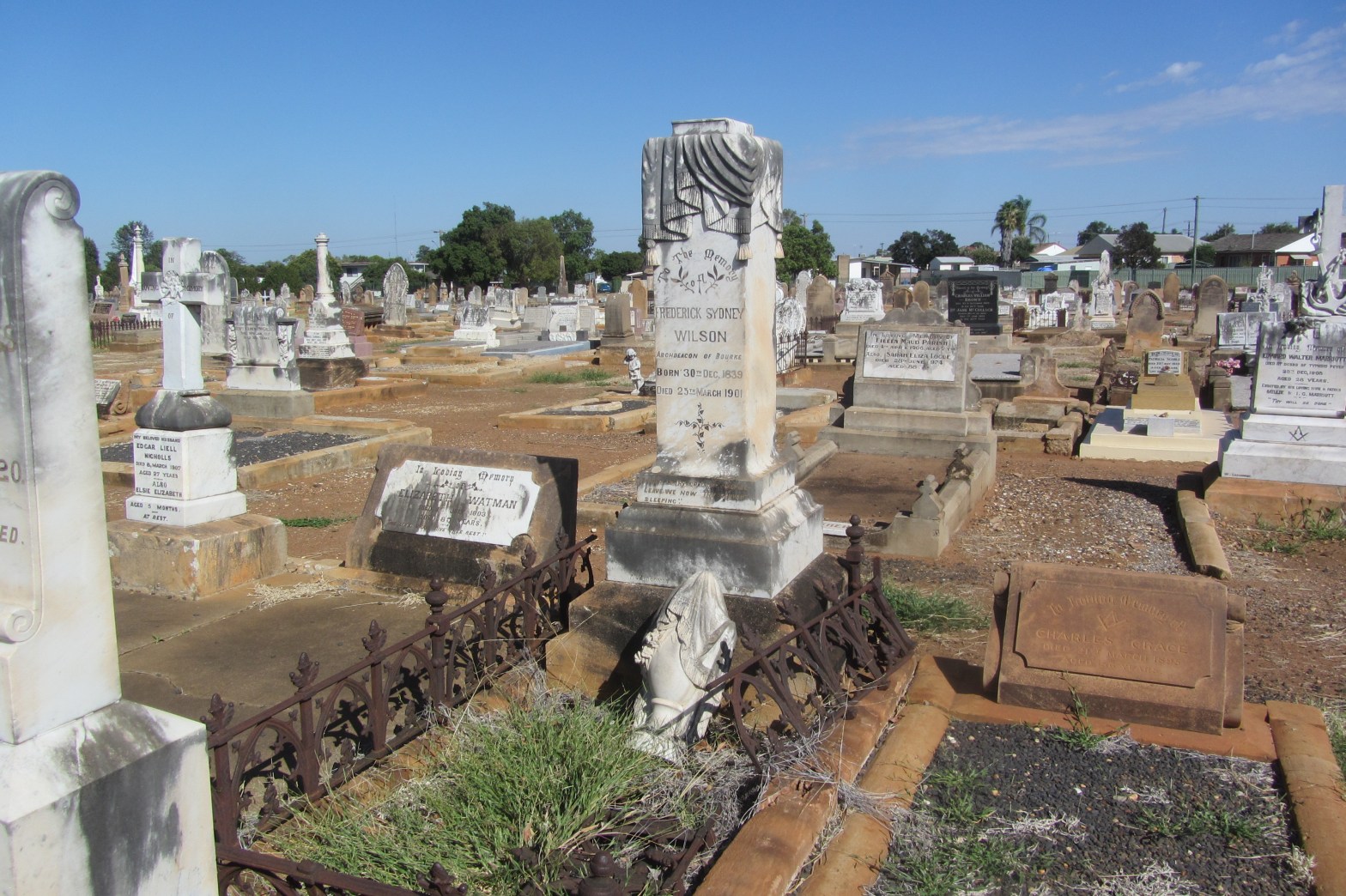
He closed one of his last sermons with, ‘I hope to meet Death as I have met Life – bravely.’ His last service was the marriage of his daughter Eva to the bank manager, Percival Smith. Archdeacon Wilson died on 25 March 1901. The funeral was the biggest seen in Dubbo at the time with over sixty vehicles in the procession. He is buried in the Old Dubbo Cemetery. He was survived by his wife, three daughters and two sons with a daughter having died in 1878.
 Trace Genealogy